Walk through most Berlin offices on a Wednesday and you'll count more empty desks than full ones. The lease doesn't care. It still bills for all of them, every month, whether anyone sits there or not. So companies do the obvious thing: they cut the floor they're not using.
What usually gets missed is the part that happens after the movers leave. The team has fewer reasons to end up in the same room at the same time, and nobody wrote that down as a cost anywhere.
More than a quarter of German companies, 26.3 percent, say their office space just isn't being used enough. 10.3 percent have already downsized, and another 12.5 percent are planning to within five years (ifo Institut, 2025). A year earlier, only 6.2 percent had actually cut space. That number has grown fast.
Large service companies are moving quickest — nearly one in five (19.2 percent) has already reduced its footprint (ifo Institut, 2025). And this isn't just a German-office quirk: a survey of 269 finance leaders across the country found that 64 percent are either cutting their traditional office space or planning to, and roughly a quarter are already running part of their operation through shared offices and coworking (IWG CFO survey, 2025).
At this point the direction isn't really in question. What's worth asking is what a company keeps and what it lets go when it shrinks.
Cutting square metres also cuts the parts of work nobody scheduled — the hallway conversation that catches a mistake before it ships, the new hire who picks up half their job just from sitting near people who already know it. None of that shows up as a line item, which is exactly why it's the first thing to quietly disappear.
There's real data behind this, not just office folklore. A large study published in Science in June 2026, covering more than 500,000 people, traced roughly a third of the recent rise in workplace mental strain back to remote work — and found that for people who live alone, the odds of going an entire day without any social contact rose by 83 percent. The researchers are upfront that most of the data is American and that the real issue isn't remote work itself, it's how loosely it's been set up. Fair enough. But the underlying logic holds regardless of country: fewer shared rooms means fewer shared moments, and that adds up.
Meanwhile in Germany, about a quarter of employees are working from home in any given month, and that share has barely moved in years (ifo Institut, 2026). It's not a phase. Downsizing the office doesn't make it go away — it just changes how much room is left for everyone to actually be together when they do come in.
If downsizing in Berlin feels risky, it's not because there's nowhere to go — the market has plenty of room, which is exactly why this is a design question, not a supply one. Vacancy hit 8.4 percent in the first quarter of 2026, up from 7.7 a year earlier, while take-up jumped almost 50 percent year over year to 171,600 square metres (CBRE, 2026). And prime rent still climbed, to 47.50 euros per square metre (JLL, 2026).
That combination is worth sitting with for a second: more empty space, and yet people paying more for the good stuff. Companies aren't chasing square metres anymore. They're chasing the parts of an office that are actually worth showing up for, and increasingly, they only want to pay for the days they use.
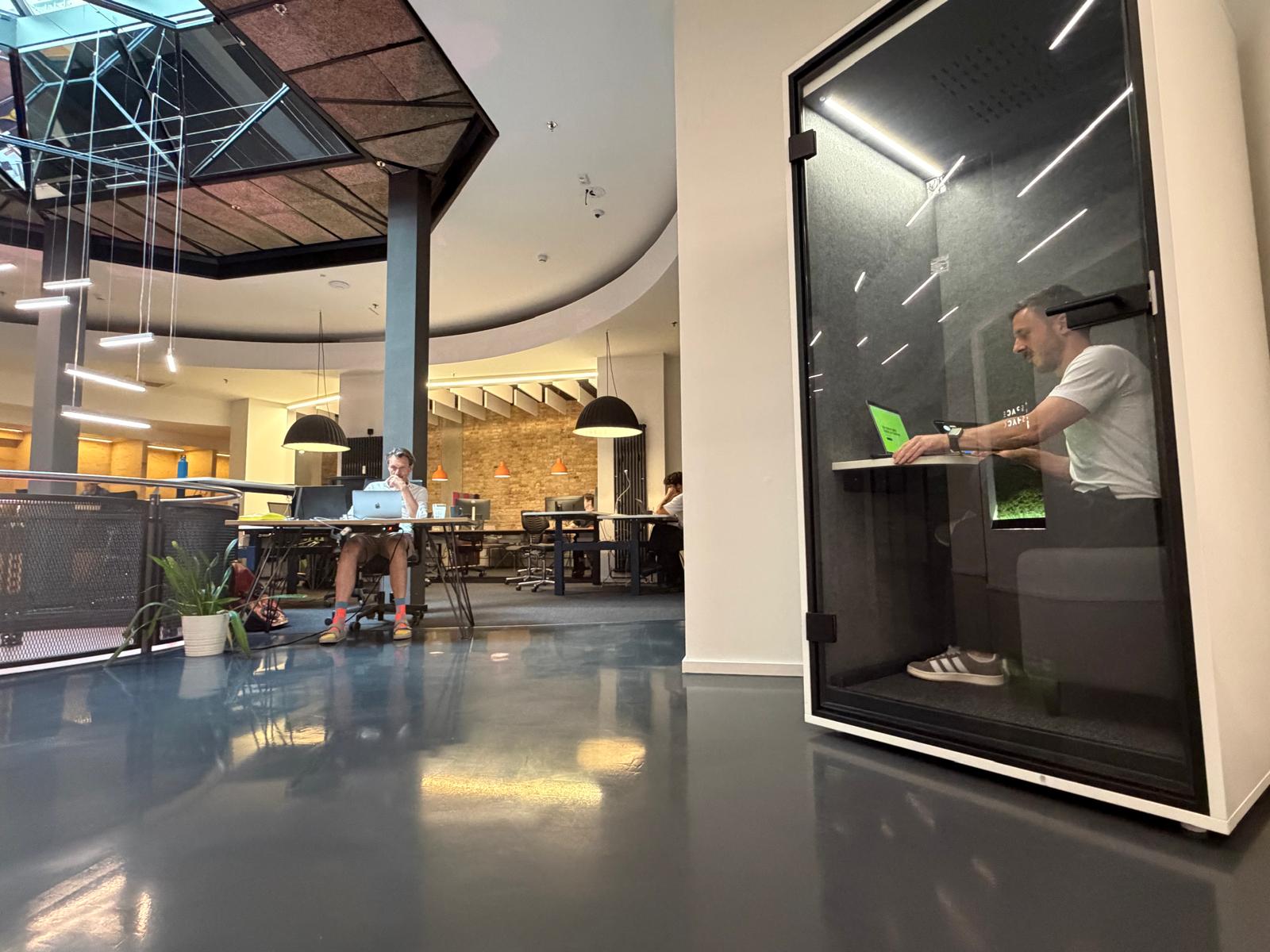
A well-run coworking space hands a smaller team back the social infrastructure it just cut from its lease — the hallway, the coffee machine, the loud lunchroom, the person whose entire job is making sure that stuff works. You don't have to rebuild any of it yourself. Someone already runs it.
At Space Shack in Berlin-Schöneberg, that's not a pitch, it's just what's been happening for ten years now: 1,400+ members, 260+ events, 700+ desks sold along the way. Free coffee, a kitchen where people genuinely sit down and eat together, a terrace, and the Hangout Hub with a table tennis table that's probably settled more disagreements than any official retro ever has. Members get 24/7 access, and our own team is on site Monday to Friday, 9 to 5, in case something needs fixing or someone just needs to ask where the stapler went. The community side isn't a feature we added on top. It's most of the point.
Cut the floor you're not using, then buy back the days that actually matter. For a team of five to fifteen in Berlin, that tends to look something like this:
For most teams, going smaller is the right call. The numbers back it up, and so does what we hear from our own members. But a smaller office that's silent and empty by three in the afternoon isn't really a saving - it's a slow leak dressed up as one. The goal with downsizing office space in Berlin isn't just less space. It's less space and more actual contact, not less of both at once.
That's the part a coworking community handles for a shrinking team - it keeps the finance department happy, and it keeps people in the same room.
Come see if it fits. Book your free trial day at Space Shack, spend a full day in the space, use the kitchen, meet the people who work there. No contract, no sales pitch. If it clicks, we'll talk about what your team actually needs.