A few years ago, the move was simple. Your team grew, so you signed a bigger lease and filled the floor. That logic is breaking. Companies in Berlin are renting less space, paying more per square metre for the good stuff, and walking away from anything tired. If you are weighing up flexible office space in Berlin right now, you are reading the market correctly.
This shift has a name. Property analysts call it the flight to quality, and the numbers behind it are getting hard to ignore.
Flight to quality means tenants are trading quantity for quality: smaller footprints in better buildings, instead of large floors in mediocre ones. The split is visible in the data. In 2025, about 27% of all office take-up in Germany went into first-occupancy quality space, and for large leases above 10,000 square metres that share jumped to 76% (ad-hoc-news, 2026).
So the best space is getting fought over while the rest sits empty. Companies are not just looking for a room. They are looking for a room that says something about how they work.
Berlin's office market is pulling apart at both ends. Prime rent climbed to 47.50 EUR per square metre per month in the first quarter of 2026, up from 46.00 EUR a year earlier (JLL Research, Q1 2026). At the same time, the average rent across the city fell to 26.85 EUR per square metre, around 6% below the year before and its lowest level in four years (Cushman & Wakefield, Q3 2025).
Read those two numbers together and the story is clear. Top space gets pricier, average space gets cheaper, and the gap between them widens. Vacancy backs this up: Berlin's vacancy rate rose to 8.4% in the first quarter of 2026, up from 7.7% a year before (JLL Research, Q1 2026). The empty buildings are rarely the good ones.
For a small team, the lesson is not to find a nicer lease. It is to stop signing the lease at all. A five-year contract on a floor you half-use is the opposite of flight to quality. You end up paying for square metres on the four days nobody is in.
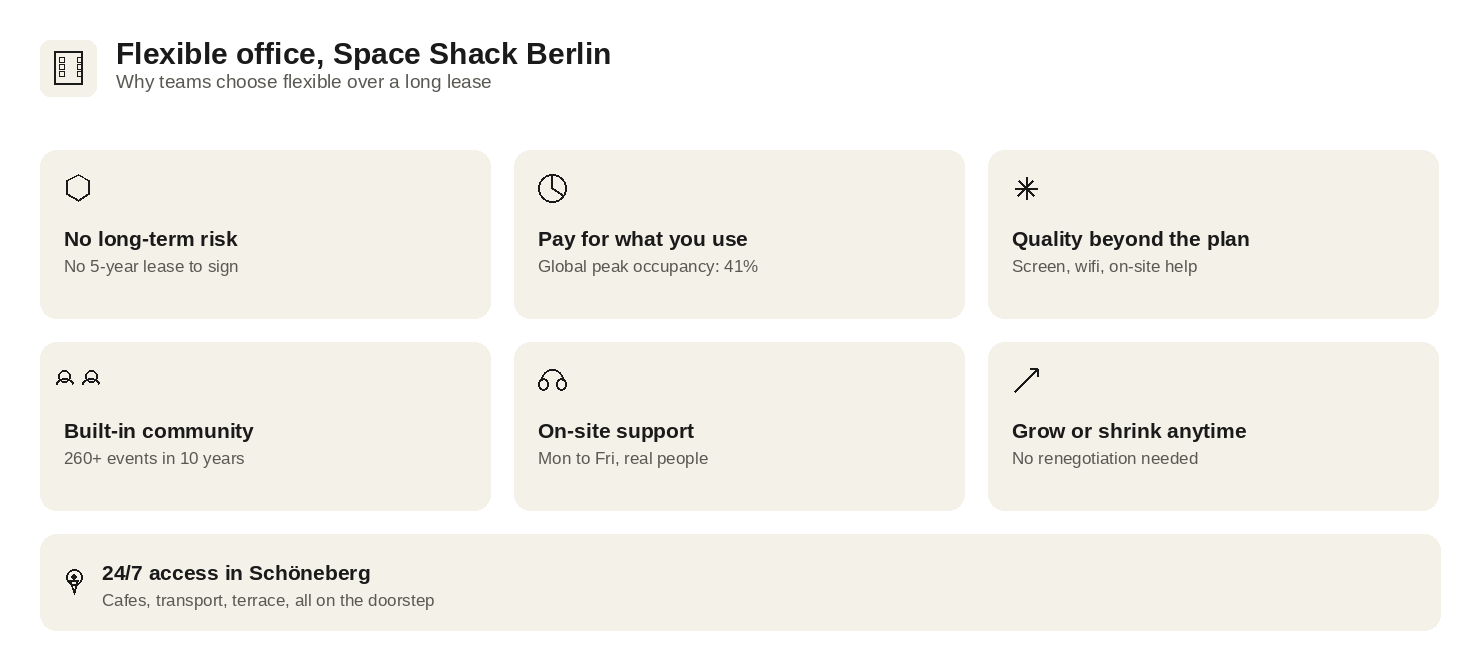
The market already moved this way. Berlin is the flex office capital of Germany, with existing and planned flexible space totalling around 330,000 square metres (Cushman & Wakefield, 2024). Teams want to book quality on demand instead of owning it forever. And occupancy data shows why empty desks are such a risk: global median peak office occupancy plateaued at 41% in 2025, even as companies pushed harder on return-to-office mandates (Basking.io, Q4 2025). You are unlikely to fill a private floor five days a week. Almost nobody does.
Here is the part the rent tables miss. Quality in a workspace is not marble in the lobby. It is whether the screen shares on the first try, whether someone is around when the wifi sulks, whether there is decent coffee without a card reader, and whether your team actually wants to come in.
That is where an independent space beats a glass tower or a faceless chain. At Space Shack in Berlin-Schoeneberg, a private office comes with the parts that make people show up: 24/7 access, on-site support Monday to Friday, free coffee, a community kitchen, a terrace, and a Hangout Hub with table tennis for when a head needs clearing. We have run this space for ten years and hosted more than 260 events in it, so the quality is lived-in, not staged.
If your lease is up, or you are setting up in Berlin for the first time, treat the flight to quality as your cue to go smaller and better. Three questions sort most of it out.
First, how much space do you truly use on a normal Tuesday, not your busiest week of the year? Size for the normal day and book extra rooms when you need them. Second, can you grow or shrink without renegotiating a contract? Flexible terms are the whole point. Third, is it somewhere your team is glad to travel to? Schoeneberg, with Akazienstrasse and its cafes around the corner, makes that an easy yes.
A lockable team office without a long lease gives you the credible address and the privacy, minus the risk. That is flight to quality for a company that does not want to gamble five years on a floor.
The market is telling small teams something useful: own less, choose better, and keep your options open. If that matches where your team is headed, come see what a flexible private office in Berlin-Schoeneberg feels like in person. Book your free trial day, bring your laptop, and spend a day working the way the rest of the week could look.